A Complete Species Guide to Aquatic Plants for Your Water Garden: What to Grow, How to Grow It, and What to Avoid — Black Koi Water Features, Serving Asheville NC, Hendersonville NC, and Greenville SC

Water plants are the most underrated element of a water garden. Most people think of them as decoration, something added after the pond is built to make it look finished. That undersells what they actually do. The right plants shade the water, pull nutrients directly from the water column, compete actively with algae, provide habitat and cover for fish, and give a feature the layered, living quality that makes it feel like it belongs in the landscape rather than sitting on top of it.
They’re also, for the most part, genuinely easy to grow. Water is a forgiving medium. You can’t overwater an aquatic plant. Most of their nutritional needs come straight from the water column. The pond moderates temperature and reduces the heat stress that kills container plants in a Carolina August.
That said, not all aquatic plants are equal. Some are spectacular and nearly foolproof in this region. Some are beautiful but aggressive. Additionally some are illegal in North Carolina or South Carolina. And a few of them we’d strongly recommend you never put in a water garden. We’ll name them directly.
This is the complete guide. It covers how to grow each plant type correctly, every species we recommend for Carolina water gardens, the novelty plants worth knowing about, the carnivorous plants that thrive here, and the ones to avoid entirely. For the broader picture of how plants function biologically within the pond ecosystem, see our guide to koi fish and water plants. This post is for when you’re ready to get into the specifics.
“If you’re looking to get your feet wet growing plants for the first time, a water garden is the perfect opportunity. You literally cannot overwater them.”
— Connor, General Manager
How Water Works as a Growing Medium

Most common plant care problems (overwatering, underwatering, soil nutrient depletion, heat stress) simply don’t apply to aquatic plants. The water handles hydration constantly. The biological activity in a healthy pond, particularly fish waste and decomposing organic material, provides the nitrogen and phosphorus most aquatic plants need without supplemental fertilization. The water also moderates temperature in ways that protect roots from heat stress.
The failure modes are different from soil plants. The things that harm aquatic plants in a water garden are ammonia toxicity from a failing biological filter, low dissolved oxygen, or being overwhelmed by faster-growing neighbors. Ammonia and dissolved oxygen are the two water chemistry parameters that most directly affect plant health. Detectable ammonia is toxic to plants and fish alike. If your plants are struggling in a system that otherwise looks healthy, test for ammonia before assuming the plants are the problem. Keep the pump running and the filtration functioning and the water chemistry tends to take care of itself.
Aquatic Plants for Your Water Garden: How to Grow Each Category Correctly
Aquatic plants fall into three main categories based on where they grow and how their roots interact with the water. Understanding the category tells you most of what you need to know about how to plant, position, and care for any specific species.
Marginal Plants for Your Water Garden
Marginal plants grow on the edges and in the shallow sections of a water garden, preferring to have their roots wet while keeping the rest of the plant above water. Pickerelweed, water iris, and impatiens are examples. These are the plants that give a pond its layered edge, the transition between open water and the surrounding landscape.
Plant marginals by working them into the gaps between larger rocks and anchoring them in place with smaller rocks packed around the base. The roots should be submerged; the foliage should not be. Most marginals dislike constant splashing. Keep them away from direct waterfall turbulence. Sweetflag and parrot’s feather are both splash-tolerant exceptions.
Trimming is the main ongoing task. Some marginals barely need dividing; others need cutting back regularly to keep them from clogging the waterfall or overtaking neighboring plants. Before winter, trim back any foliage dying down for the season so it doesn’t decompose in the water and add to the nutrient load.
Fertilizing marginals is generally unnecessary in a pond with fish. Fish waste provides more than enough nutrients. In a lower-nutrient system, one fertilizer tablet per month between May and September is appropriate for species that benefit from it. Always err conservative. Excess nutrients feed algae as directly as they feed plants.
“With fertilizing, we always tell people to err on the safe side. Excess nutrients are one of the main drivers of algae problems, and a little goes a long way in a water garden.”
— Connor, General Manager
Floating Plants for Your Water Garden
Floating plants grow across the water surface unattached to any substrate. They pull nutrients directly from the water through their roots and block sunlight, both of which compete directly with algae. Water hyacinth, water lettuce, duckweed, and American frogbit are the floating plants we work with most often in Carolina water gardens.
Care is minimal. Drop them on the surface and they grow. No potting, no anchoring, no fertilization needed. The main management task is thinning. Floating plants spread aggressively in favorable conditions and can cover the entire pond surface if left unchecked.
Two dynamics to understand: in ponds with koi, many floating plants are essentially fish food. Koi will eat water hyacinth, lettuce, and duckweed readily and may clear them entirely. That’s fine; just plan around it. In ponds without fish, some smaller floating species like duckweed and fairy moss can become nearly impossible to remove once established. Fish are the only practical control for the most aggressive floating species.
Many floating plants are invasive and regulated. Water hyacinth, water lettuce, and several other common floating plants are illegal in some states. Verify with your local regulatory agency before adding any non-native floating plant to an outdoor water garden in Western NC or Upstate SC.
Submerged and Emergent Plants for Your Water Garden
This category covers plants that live primarily underwater or that grow from below the surface and emerge above it: water lilies, lotus, hornwort, and mosaic plant among others. Care requirements vary more within this category than any other.
Plants without a fixed base, like hornwort, can be loosely anchored to the bottom with rocks or left to drift freely through the water column. They don’t need potting or fertilization and are among the easiest plants to establish.
Water lilies and lotus are different. Both perform significantly better in high-nutrient conditions: rich organic substrate rather than the relatively clean water column. The correct approach is to pot them in a container with nutrient-rich soil, such as plain topsoil, then cover the substrate with small rocks to hold it in place and prevent it from clouding the water. This gives the plants the nutrient density they need without releasing that load into the pond.
Both benefit from fertilizer tablets added to the pot and buried among the root system where fish can’t reach them. Aquascape makes slow-release tablets specifically for aquatic plants that only need replacement once a year. Remove dead lily pads when they appear. They drain energy and nutrition that would otherwise go toward new growth and flowering.
Plants We Love: A Complete Species Guide to Plants for your Water Garden
Every species below is one we work with and recommend for water gardens in Western North Carolina and Upstate South Carolina. Each entry includes hardiness zone information and an honest assessment of performance, care requirements, and fit.
Many aquatic plants have invasive potential and are regulated or prohibited. Some plants on this list are illegal in parts of NC or SC. Always verify with local regulatory agencies before adding non-native species to an outdoor water garden.
The Foundation: Workhorses for Any Carolina Water Garden
American Water Lily (Nymphaea spp.) Beautiful | Cold Tolerant | Native NC/SC


Perennial, Zones 3–11 depending on variety
The single most important plant in any full-sun water garden. Hardy water lilies bloom and re-bloom all summer. Their broad floating pads shade the water and compete with algae better than anything else in the pond. Native varieties come in a wide range of flower colors. Plant in nutrient-rich substrate with the pot covered in small rocks to contain the soil. Remove dead pads promptly. They drain the plant’s energy. Refertilize the pot each spring.
Water Iris (Various) Beautiful | Cold Tolerant | Native NC/SC | Easy


Perennial, Zones 3–9 depending on variety
Hardy, slow-growing, and elegant. Water iris produces white, purple, or yellow flowers in late spring to early summer. It grows slowly enough that it rarely needs dividing, making it one of the lowest-maintenance marginals available. Several varieties are native to the Southeast. Our go-to vertical accent plant for pond edges in this region. It works in almost any placement and never causes problems.
Sweetflag (Acorus calamus) Cold Tolerant | Easy


Perennial, Zones 3–9 depending on variety
Short, yellow-variegated bladed plant similar in form to a grass or iris. Grows slowly, stays tidy, tolerates splashing, and adds a color variety that most other marginals don’t provide. One of the most reliably low-maintenance plants we work with. Useful in waterfall-adjacent placements where other marginals struggle with constant moisture.
Horsetail Reed (Equisetum hyemale) Beautiful | Cold Tolerant | Native NC/SC | Easy


Perennial, Zones 4–9
No leaves, no flowers. Just striking segmented stems with a prehistoric quality that photographs beautifully and creates strong vertical structure at the water’s edge. Hardy, easy to establish, and visually unlike anything else in the plant palette. Can spread vigorously in ideal conditions; containing it in a pot gives you the look without the spread.
Creeping Jenny (Lysimachia nummularia, various) Beautiful | Cold Tolerant | Easy


Perennial, Zones 3–9
A low trailing groundcover that spills beautifully over pond edges and into the water margin. Light green, fine-textured, and softening. It makes a rock edge look finished rather than constructed. Easy to establish. Can die back if frozen into ice, but portions growing outside the water garden typically survive and recolonize the edge as temperatures warm.
Pickerelweed (Pontederia cordata) Cold Tolerant | Native NC/SC | Easy


Perennial, Zones 3–10
Medium-sized marginal with arrow-shaped leaves and purple flower spikes. Grows faster than water iris and needs more regular trimming, but it supports native pollinators actively and integrates naturally into the Appalachian landscape. Native throughout much of North America. A reliable choice for ponds where some natural exuberance is welcome.
Hornwort (Ceratophyllum demersum) Cold Tolerant | Native NC/SC | Easy


Perennial (re-emerges from pods in spring), native throughout NC/SC
Grows almost entirely underwater, floating freely through the water column or anchored loosely to the bottom. Native to North and South Carolina, it overwinters reliably without any intervention, dropping pods in fall that re-emerge in spring. Fast-growing and genuinely useful for oxygenating the water and providing habitat for aquatic insects and juvenile fish.
High Impact: Beautiful Plants for Your Water Garden With Strong Performance
Water Hibiscus / Scarlet Rosemallow (Hibiscus coccineus) Beautiful | Cold Tolerant | Native NC/SC | Easy


Perennial, Zones 6–9
Produces plate-sized bright red flowers on stems that can reach 10 feet tall. Nothing else in the water garden makes a statement at this scale. Green and red stems give it visual interest even out of bloom. Dies back to the ground in fall and re-emerges reliably in spring. One consideration: decomposing leaves and petals can release tannins into the water, producing a tea color. Harmless to fish but worth knowing if water clarity is a priority.
American Frogbit (Limnobium spongia) Beautiful | Cold Tolerant | Native NC/SC | Easy

Perennial (re-emerges from dropped buds in spring), Zones 4–10
A native floating plant significantly larger than duckweed or fairy moss, making it a practical tool for blocking sunlight and pulling nutrients from the water column. Produces small white flowers. Because it’s native to the eastern United States, it’s legal without the invasive concerns attached to water hyacinth and water lettuce. A rare combination of utility, beauty, and legal status in the floating plant category.
Forget-Me-Not (Myosotis spp.) Beautiful | Cold Tolerant | Easy


Perennial, Zones 3–9 depending on variety
Small wildflowers with blue blooms and yellow centers that grow well in shallow water up to four inches deep. Shorter than most marginals, with a fast sprawling growth habit that fills edge coverage gaps beautifully. Adds color and texture at a scale that taller plants can’t.
Note: Grows best in no more than 4 inches of water. Some species have invasive potential. Verify before planting.
Parrot’s Feather (Myriophyllum spp.) Beautiful | Easy


Perennial, Zones 6–11. Red-stemmed variety is more cold-tolerant
A lovely plant that grows across the water surface in feathery, arching sprays. Anchors to the sides of the feature and tolerates splashing well, one of the few marginal-adjacent plants that does. The red-stemmed variety overwinters better in WNC conditions than the green-stemmed. Useful where water hyacinth isn’t legal.
Note: Illegal in some states. Verify before planting.
Hostas (Various) Beautiful | Cold Tolerant | Easy


Perennial, Zones 3–9 depending on variety
Hostas bring a traditional garden feel to the water garden edge, growing more like a bush than a typical marginal. Cold tolerant, familiar to most gardeners, and easy to source. Work well in partially shaded pond edges where most aquatic marginals struggle for light. The visual contrast between hostas and true aquatic marginals gives a planting palette welcome variety.
Ferns (Various) Cold Tolerant | Native NC/SC

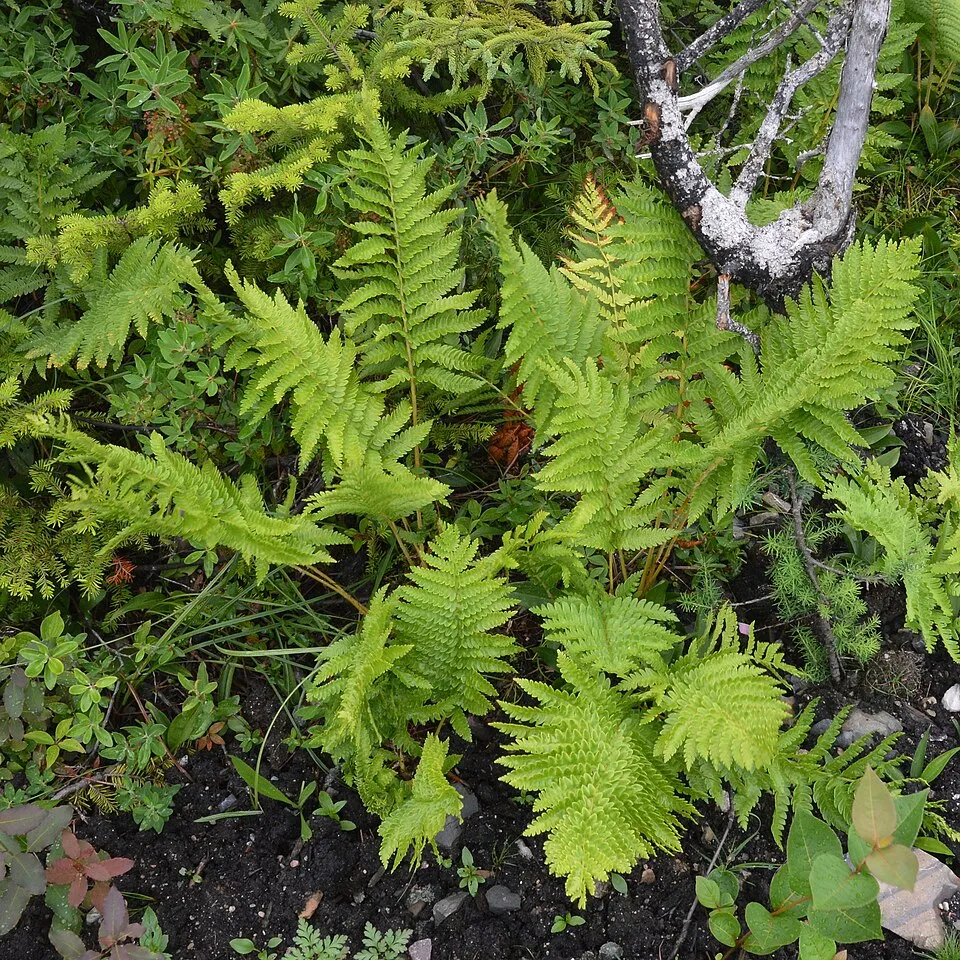
Perennial, Zones 3–11 depending on species
Ferns are charming, low-profile plants that bring a familiar woodland quality to the water garden edge. Many species do well in water gardens, though they don’t like their fronds to get wet so position them in the splash-free margins rather than directly at the waterline. Most prefer relatively low light, which makes them useful in the shaded sections of a pond where other plants struggle to perform.
Some varieties do well in partial sun. In Western NC and the Appalachian landscape specifically, native fern species integrate naturally into the surrounding environment in a way few other plants can match. They look like they’ve always been there because in most cases, they have been. Growth is modest and they rarely cause management problems.
Water Celery (Oenanthe javanica) Beautiful | Cold Tolerant | Easy


Perennial, Zones 5–10
Fast-growing marginal with distinctive green, white, and occasionally red coloring that spreads across pond edges and over the water. Visually unusual: the color combination is eye-catching in a way most aquatic plants aren’t. Needs regular trimming in favorable conditions. Worth it for the visual distinctiveness it adds to a planting palette.
Fairy Moss / Mosquito Fern (Azolla caroliniana) Beautiful | Cold Tolerant | Native NC/SC | Easy


Perennial (re-emerges from spores in spring), Zones 7–11
The world’s smallest fern and a native of the eastern United States. Gets its common name from its reported ability to deter mosquitoes from laying eggs in the water it covers. Produces beautiful red and green coloring, particularly in stream sections with good flow. Grows fast enough to cover the pond surface in ponds without fish. Fish eat it readily and keep it controlled. Nearly impossible to remove without fish.
Duckweed (Lemna spp. and related species) Cold Tolerant | Native NC/SC | Easy


Perennial in warmer zones. Re-emerges in spring in colder climates, Zones 4–10
Duckweed is the smallest flowering plant in the world and one of the most ecologically active in a pond. It spreads across the water surface in a dense lime-green mat, blocking sunlight and pulling nutrients from the water with exceptional efficiency — both things that directly suppress algae. In ponds with fish it’s effectively self-limiting: koi and goldfish eat it readily and can clear it completely. In ponds without fish it will cover the surface entirely within weeks in warm weather and is nearly impossible to remove manually. If you have fish and want a plant that works hard for the ecosystem without any attention from you, duckweed earns its place. If you don’t have fish, skip it.
Note: Can be extremely difficult to remove without fish. Not recommended for ponds without a fish population to control its spread.
Soft Rush (Juncus effusus) Cold Tolerant | Native NC/SC | Easy


Perennial, Zones 4–9
Medium-height grass-like plant that grows naturally along lake and stream edges throughout the Appalachian region. Thrives in high light. Commonly found in the wild near the water gardens we build in this region. Using it reinforces the sense that the feature belongs in the landscape. Produces only small, subtle flowers but contributes a natural native quality that works well in naturalistic designs.
Dwarf Horsetail (Equisetum scirpoides) Beautiful | Cold Tolerant | Easy


Perennial, Zones 4–10
Looks and grows like a fine lawn grass: soft, light-textured, warm light green. Where standard horsetail reed is bold and architectural, dwarf horsetail is delicate and grounding. Fills a visual niche in water garden planting that nothing else occupies quite the same way. Easy to establish and cold tolerant.
Water Hawthorn (Aponogeton distachyos) Beautiful | Cold Tolerant | Easy


Perennial, Zones 5–11
An underwater emergent plant similar in habit to a water lily but with elongated rather than round pads. Produces white flowers that form just above the water surface. Prefers nutrient-rich substrate and benefits from fertilization in growing months. Adds submerged plant diversity, with a form and flower that lilies and lotus don’t provide.
Water Poppy (Hydrocleys nymphoides) Beautiful


Perennial in Zones 9–11. Grown as an annual in colder climates
Spreads like a lily pad but produces bright yellow flowers that look remarkably similar to a poppy. Adds flower color variety that water lilies and lotus don’t offer. Not as cold tolerant as American water lilies, functioning as an annual in WNC and Hendersonville. The flowers are distinctive enough to justify replanting each season for the right pond.
American Water Lotus (Nelumbo lutea) Beautiful | Cold Tolerant | Native NC/SC
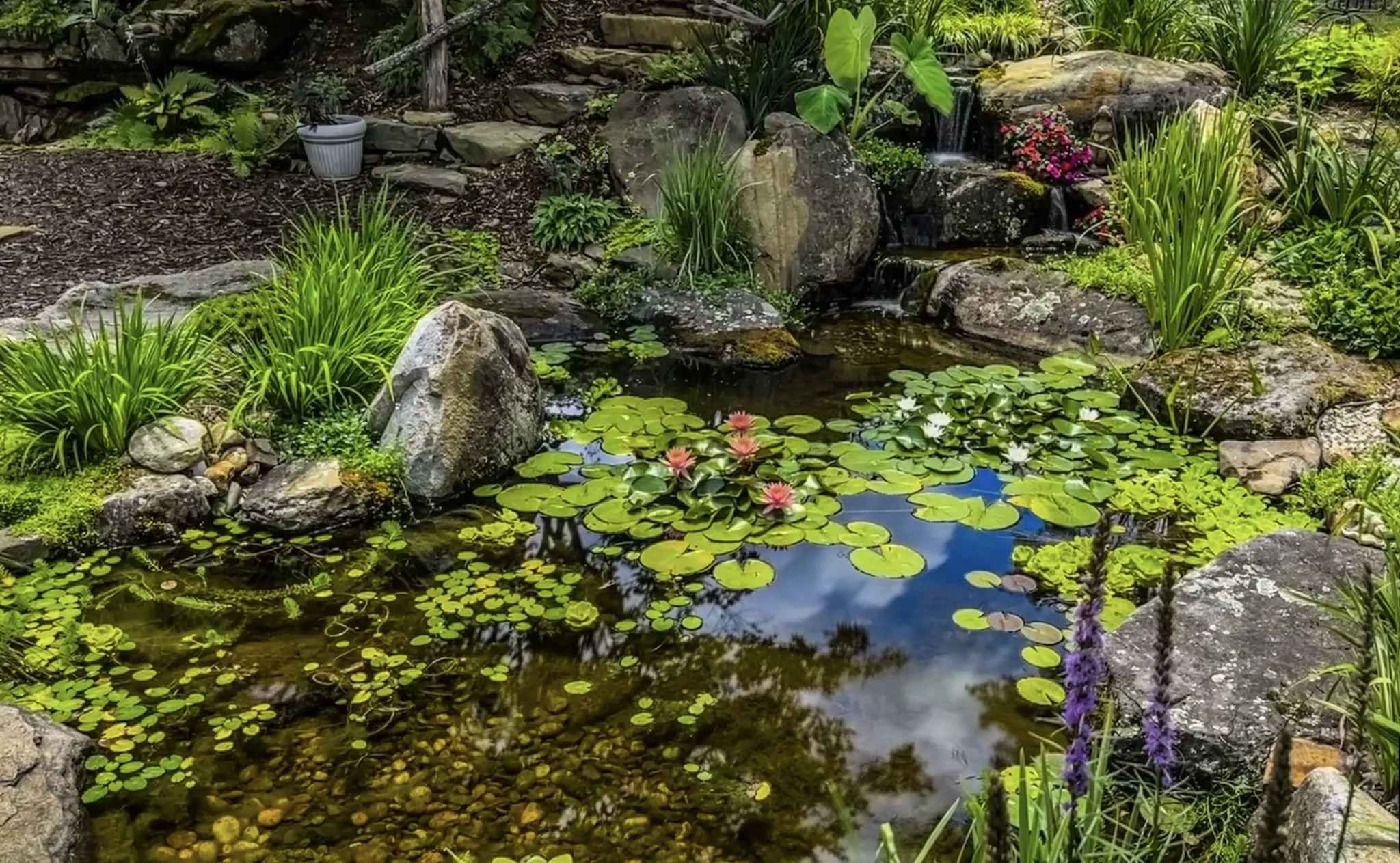

Perennial, Zones 2–11
Among the most iconic water garden plants. Can grow to five feet, with striking yellow flowers and pads that rise above rather than float on the water surface. Prefers very high-nutrient substrate and demands more attention than most aquatic plants. It is among the more challenging species on this list. Rewards that attention with a presence nothing else in the water garden matches. Plant in a deep pot with rich substrate, fertilize regularly, and give it the sunniest position available.
Water Papyrus (Cyperus papyrus) Beautiful | Easy


Perennial in Zones 9–12. Annual in cold climates
Native to warm African climates. Cylindrical green stem with a dramatic fan-like tip, structurally unlike anything else in the aquatic plant palette. Doesn’t overwinter in WNC or Hendersonville and is grown as an annual or overwintered indoors. Worth it as a seasonal statement plant for larger features where the exotic structural form earns its place.
Canna Lily (Zantedeschia spp.) Beautiful | Easy


Perennial, Zones 7–10
Grows two to three feet tall and produces striking colors in a wide variety of cultivars. Can be planted in water up to 12 inches deep. Thick, stiff leaves and stems in genuinely interesting colors. A useful tool for adding height and color to a pond edge without reaching for the most common options.
Impatiens (Impatiens walleriana) Beautiful


Perennial in Zones 10–11. Annual in Zones 2–9
Small flowering plants with colorful blooms and the seed pods that burst under pressure, which makes them one of the more interactive plants available. Grow best with only their bases submerged and prefer partial to low sunlight. Short enough for shaded edge positions where taller marginals wouldn’t fit. Annual in most of our service area.
Sweet Potato Vine (Ipomoea batatas) Beautiful | Easy


Perennial in Zones 9–11. Annual in Zones 2–8
Available in multiple varieties with striking leaf colors. Sprawling, hanging form makes it particularly effective in waterfall sections where other plants sit too upright. Produces white and purple flowers. Grown as an annual in WNC and Hendersonville but worth using seasonally for the color and texture it adds to rock faces.
Water Lettuce (Pistia stratiotes) Beautiful | Easy Tropical floating plant.


Annual in most of NC and SC
Water lettuce is a floating rosette plant with soft, velvety pale green leaves that spread across the water surface. It’s a fast grower and an effective one — its roots hang beneath the surface and pull nutrients directly from the water column, which makes it a genuine contributor to water quality rather than just a surface covering. Pairs well with water hyacinth for filling gaps in surface coverage on full-sun ponds. Koi eat it, which naturally limits its spread in ponds with fish. In ponds without fish it can spread aggressively. Does not survive frost and needs to be replanted each season in WNC and Hendersonville.
Note: Illegal in some states. Verify legality before purchasing.
Water Hyacinth (Pontederia crassipes) Beautiful | Easy


Tropical floating plant. Annual in Zones below 9
Fast-growing floating plant closely related to pickerelweed with similar colors and flowers. Produces beautiful purple blooms in the right conditions and spreads by self-duplication. Excellent at pulling nutrients from the water column. Koi eat it readily. Annual in most of NC and SC. Plan to replant each season.
Note: Illegal in some states. Verify legality before purchasing.
Moss — A Category of Its Own
Moss (Various, including Springy Turf Moss) Beautiful | Cold Tolerant | Native NC/SC | Easy
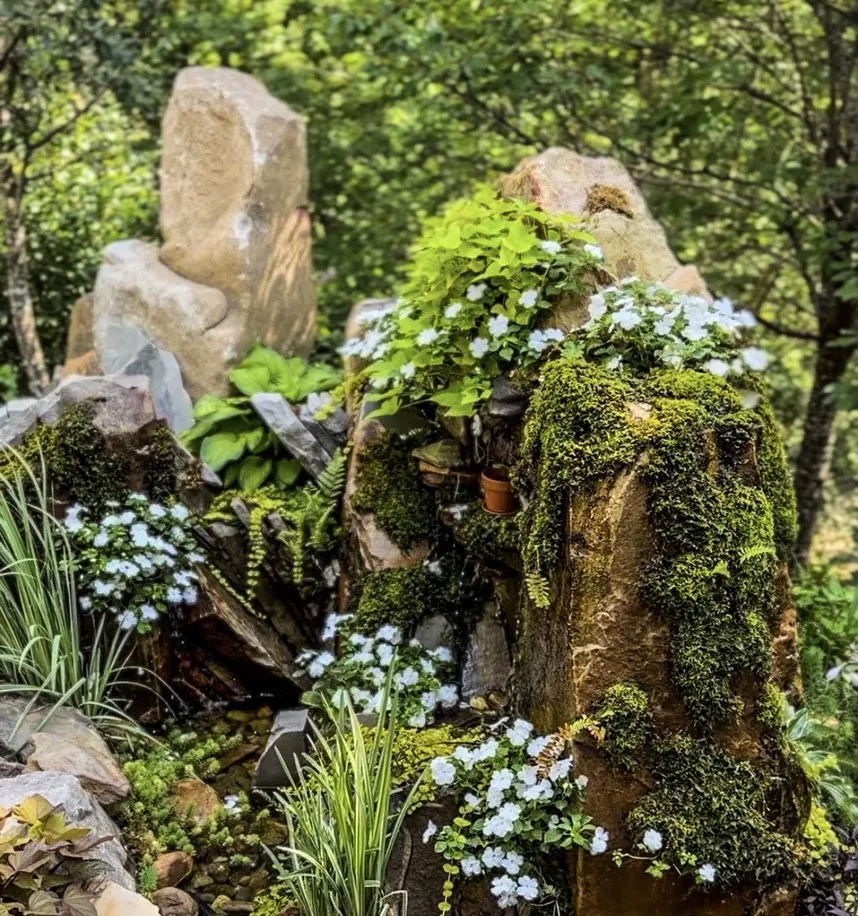

Perennial, Zones 2–11 depending on species
Moss occupies a unique role in water garden planting. It prefers moist, low-light environments, exactly the kind of conditions found in shadowed crevices between rocks around a waterfall or stream. When it establishes, it gives a feature a quality of age and permanence that no other plant provides as quickly. A rock face with good moss coverage looks like it has been there for decades.
“When we plant moss, we get multiple varieties and place them where we hope they’ll grow. Some of it spreads right where we put it. Some floats free and attaches somewhere else. New mosses move in on their own over time. You can’t force it — the best approach is to maximize the opportunities for it to establish and let it find its spots.”
— Connor, General Manager
Press several moss varieties into rock crevices and shaded surfaces throughout the feature and observe what takes hold. Springy Turf Moss is our most common introduction and the one we’ve seen establish most reliably in the Appalachian landscape. The feature tends to develop its own moss character over time. That’s part of what makes each one genuinely different.
Novelty Plants for Your Water Garden: The Unexpected Additions
These plants don’t fit neatly into the standard categories, but they’re worth knowing about. Each one brings something genuinely unusual to a water garden, the kind of addition that generates conversation and makes a pond memorable for reasons beyond fish and flowers.
Sensitive Plant (Mimosa pudica)


Perennial in Zones 10–12. Annual in Zones 2–9. Must be overwintered indoors in WNC and Hendersonville.
The sensitive plant grows from the water edge and sprawls just above the surface. Its defining quality is touch sensitivity. When pressure is detected, the leaves fold closed. It’s also a member of the pea family and can fix atmospheric nitrogen through root bacteria, contributing nutrients rather than just consuming them. Not cold tolerant, requiring indoor overwintering in our climate. Worth it for water gardens where interaction and conversation are part of the appeal.
“The sensitive plant is one of those things that seems small but gets a reaction every single time. Guests touch it, the leaves close, and suddenly everyone at the party is crowded around the pond trying it.”
— Connor, General Manager
Mosaic Plant (Ludwigia sedioides)


Perennial in Zones 10–12. Annual in Zones 2–9.
Among the most visually striking aquatic plants available. Emerges from the water in a spiral pattern with four-sided red and light green leaves that create a geometric mosaic across the surface. Prefers warm, slow-moving water, high light, and nutrient-rich conditions. Dies back as temperatures drop. A tropical statement plant for the right pond and the right placement.
Exotic and Tropical Water Lilies


Typically Zones 9–12 perennial. Grown as annuals in Zones 2–8.
Beyond native American water lilies, tropical varieties offer an extraordinary range of flower colors and forms, including night-blooming varieties and some with dramatically upright flowers. At the extreme end, Victoria species from the Amazon produce pads large enough to support a child and defend themselves with undersurface thorns. Tropical lilies die with the cold and are best planted in nutrient-rich pots for easy fall removal. Benefit from regular tablet fertilization. Best considered as seasonal additions for larger ponds.
Carnivorous Plants for Your Water Garden: Western NC’s Native Specialties
Western North Carolina and coastal South Carolina are home to some of the most remarkable carnivorous plants in North America. These plants evolved in nutrient-poor bogs and wetlands where trapping insects provides access to nitrogen and phosphorus unavailable in the substrate. That evolutionary background shapes their care: most prefer low-nutrient, acidic conditions nearly opposite to what a typical water garden provides.
They’re more demanding than most aquatic plants, but genuinely extraordinary. For a water garden in this region, using plants native to local bogs and wetlands creates a layer of authenticity that resonates.
Venus Fly Trap (Dionaea muscipula)


Perennial, Zones 7–10. Native to the NC and SC coastal plains.
One of a kind in the plant world. Pressure-sensitive traps close when triggered. They can distinguish between a raindrop and an insect, closing fully only when the trigger hairs are activated twice within a short window. Native to the coastal plains of North and South Carolina, making this a genuinely local plant despite its exotic reputation. Prefers damp but not fully submerged substrate and demands low-mineral water. Source from a reputable cultivated supplier. Vulnerable to poaching. Among the more challenging plants on this list but achievable with the right setup.
Pitcher Plants (Sarracenia spp.)


Perennial, Zones 2–10 depending on variety. Several species native to NC/SC.
Carnivorous plants that trap and digest insects in their tube-shaped bodies. The range of forms is remarkable: short purple pitchers, tall yellow-green tubes, hanging red and green varieties, each with the characteristic veining and hood that prevents rainwater from diluting the digestive liquid inside. Several species are native to North Carolina and South Carolina bogs. Prefer acidic, low-nutrient, low-mineral conditions. Cold tolerant across most varieties, which makes them more viable in WNC conditions than many other carnivorous plants.
Sundew (Drosera spp.)


Perennial, Zones 3–10 depending on variety
Small carnivorous plants that produce glistening droplets of sticky liquid on their leaf surfaces, beautiful from a distance and lethal to any insect that makes contact. Require very pure water, acidic substrate, and damp but not submerged conditions. Among the more challenging to keep in a standard water garden setting, but the visual effect of their jewel-like surfaces in the right light is unlike anything else available.
Plants to Avoid: What We’d Never Put in a Water Garden
After building and maintaining water features across Western NC and Upstate SC for 25 years, we’ve seen what happens when the wrong plants get established in a pond. Some look fine when young. That changes. The plants below are ones we’d never recommend, and we’ll tell you exactly why.
Cat Tails (Typha spp.)


Cold Tolerant | Native NC/SC | Zones 2–10
“Cat tails come up sometimes and we always say the same thing: don’t. Once they’re in they’re extremely difficult to get out. There are better options that look similar and won’t take over your pond.”
— Connor, Construction Foreman
Cat tails grow fast, spread aggressively through underground rhizomes, and once established become extraordinarily difficult to remove. Their seed pods disperse widely. Their root systems anchor so deeply that manual removal is brutal work that rarely succeeds completely. For the vertical accent and native feel that cat tails provide, grow water iris or soft rush instead. Both deliver similar form, grow at a manageable pace, and won’t require an excavation to remove.
Bulltongue Arrowhead (Sagittaria lancifolia)


Cold Tolerant | Native NC/SC | Zones 8–11
Unremarkable looking and remarkably difficult to remove. Develops exceptionally robust root systems that anchor deeply and spread from one section of the pond to another. Getting it out requires real effort and rarely succeeds completely. For anything resembling what this plant offers visually, pickerelweed and canna lilies both look better, grow manageably, and won’t require a reconstruction to eliminate. Not worth it under any circumstances.
Taro (Colocasia spp.)

Beautiful | Cold Tolerant | Zones 8–11
Taro is the only plant in this category with genuine visual merit. It produces beautiful leaves in striking color varieties and works as a shading plant in the right setup. The problem is removal. Taro grows quickly, and when you cut it back or remove it, the plant produces calcium oxalate crystals that cause intense skin irritation. The combination of fast growth and painful removal isn’t worth it for most water gardens. If you want taro, plant it in a removable container from the start. Never directly into the rock. At least that way you control the interaction.
Plants for Your Water Garden: Frequently Asked Questions
How often should I fertilize aquatic plants in WNC or Upstate SC?
Most aquatic plants in a pond with fish don’t need supplemental fertilization. Fish waste provides more than enough nitrogen and phosphorus. Water lilies and lotus are the main exceptions: fertilizer tablets pushed into the pot substrate once or twice a season make a visible difference in bloom performance. In a lower-nutrient system without fish, one tablet per month between May and September is appropriate for species that benefit from it. Always err conservative. Excess nutrients feed algae as directly as they feed plants.
What should I do with my plants before winter?
The approach depends on whether the plant is an annual or a perennial. Tropical and annual plants (water hyacinth, water lettuce, water papyrus, sensitive plant, tropical lilies) should be removed before they die in the water and release their stored nutrients back into the pond. Start this process when water temperature drops to around 60°F or when air temperatures are consistently hitting the low 40s. Perennial plants should be trimmed back as they go dormant. Hardy water lilies overwinter in-pond reliably in most of NC and SC and don’t need to be removed.
Are aquatic plants sensitive to water chemistry?
In our experience, ammonia and dissolved oxygen are the two parameters that directly affect aquatic plant health. Ammonia is toxic to plants and fish alike. If your plants are struggling in a system that otherwise looks healthy, test for ammonia before assuming it’s a plant problem. Low dissolved oxygen compromises the biological filter, which affects water quality, which affects plants. Both are addressed by keeping the pump and filtration functioning correctly.
Do aquatic plants need soil?
Most aquatic plants are anchored between rocks. Work them into gaps between larger rocks and secure with smaller ones packed around the base. Water lilies and lotus are the main exceptions. Both do significantly better when potted in nutrient-rich organic substrate with the soil covered in small rocks to contain it. Aquascape makes slow-release fertilizer tablets designed for this use that only need replacement once a year.
How do I choose the right plants for my specific water garden?
Start with sun exposure, then think about what roles you want the plants to fill. For a full-sun pond, water lilies are the non-negotiable starting point. Add marginals for edge definition and vertical interest. In partial shade, water iris and sweetflag work beautifully with less attention than sun-loving species. For the edge and waterfall areas, creeping jenny, parrot’s feather, moss, and water celery give you the sprawling, softening quality that makes rock transitions look natural.
In Western NC and Upstate SC specifically, our staple combination is: water lilies for surface coverage, water iris and sweetflag as the primary marginals, creeping jenny and moss for the edges, and horsetail reed for vertical structure. Everything else on this list builds on that foundation.
Where should I buy aquatic plants for my water garden?
Aquatic plants occasionally appear at local garden centers and fish stores, but selection is limited and quality inconsistent. For a wider and more reliable range of species, ordering online from a reputable aquatic plant nursery is the most practical approach. When buying floating plants especially, verify legality in your specific location before placing an order. Regulations vary by state and county.
Which plants best support native wildlife in WNC and Upstate SC?
Most native aquatic plants support local wildlife simultaneously across multiple species. Marginals like pickerelweed support native bees through their flowers and provide habitat for dragonfly larvae and frogs. Timing your flowering plants across the season (water iris in late spring, pickerelweed through summer, native hibiscus in late summer) gives pollinators a continuous food source. Submerged plants like hornwort provide oxygen and shelter for aquatic insects and juvenile fish. Floating plants provide food for native ducks and amphibians. If supporting local species is a priority, build a planting palette with native species across multiple bloom times rather than focusing on any single plant.
Ready to Talk Through Your Planting Plan?
Planting design is one of the most personal parts of a water garden,, and one of the most consequential for how it looks and performs over time. The right plants make a pond genuinely self-sustaining. The wrong ones create maintenance problems that compound season after season.
If you’re planning a new water garden or looking to improve the planting on an existing one, send us photos through the contact form. Tell us what you’re working with: sun exposure, feature type, what’s already in it. We’ll talk through what makes sense. We respond within 24 hours.
Visit blackkoiwaterfeatures.com → fill out the contact form → send us photos of your water garden. We respond within 24 hours.
— Connor and the Black Koi Water Features Team
Asheville, NC | Hendersonville, NC | Greenville, SC | Western NC & Upstate SC
